
3. Sea Surface Temperature#
SST is a challenging parameter to define precisely as the upper ocean (~10 m) has a complex and variable vertical temperature structure that is related to ocean turbulence and air-sea fluxes of heat, moisture and momentum. A theoretical framework is therefore required to understand the information content and relationships between measurements of SST made by different satellites and in situ instruments, especially if these are to be merged together. The definitions of SST developed by the GHRSST SST Science Team (agreed at the 2nd and 3rd workshops) achieve the closest possible coincidence between what is defined and what can be measured, taking into account current scientific knowledge and understanding of the near-surface thermal structure of the ocean.
The definitions of SST have been refined by the GHRSST Science Team. The GHRSST SST definitions have also been iterated with the Climate and Forecast (CF) metadata convention [1] definitions of SST to ensure they are in agreement.
The figure below presents a schematic diagram that summarises the definition of SST in the upper 10 m of the ocean and provides a framework to understand the differences between complementary SST measurements. It encapsulates the effects of dominant heat transport processes and time scales of variability associated with distinct vertical and volume regimes of the upper ocean water column (horizontal and temporal variability is implicitly assumed).
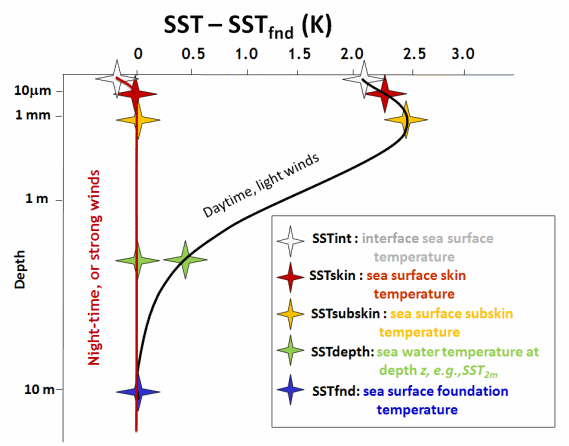
Fig. 3.1 Overview of SST measurement types used within GHRSST#
The following sections provide the precise definition by GHRSST Science Team
for each type of sea surface temperature represented in
Fig. 3.1, with the GHRSST official short name (used to fill
in <SST Type>) in product identifier and filename for instance, and the CF
standard name definition.
3.1. Interface sea surface temperature (SSTint)#
CF Definition [sea_surface_temperature]
sea_surface_temperature is usually abbreviated as “SST”. It is the
temperature of sea water near the surface (including the part under sea-ice,
if any), and not the interface temperature, whose standard name is
surface_temperature. For the temperature of sea water at a particular
depth or layer, a data variable of sea_water_temperature with a vertical
coordinate axis should be used.
Additional details
The interface temperature (SSTint) is a theoretical temperature at the
precise air-sea interface. It represents the hypothetical temperature of the
topmost layer of the ocean water and could be thought of as an even mix of
water and air molecules. SSTint is of no practical use because it cannot be
measured using current technology. It is important to note that it is the
SSTint that interacts with the atmosphere. Within GHRSST, most variables
containing SST are named sea_surface_temperature to simplify the development
of client applications wishing to read these variables. The variable
attribute standard_name indicates the precise form of the SST, using the
following definitions. More detail is given in the Level 2P (Section 7),
Level 3 (Section 8), and Level 4 (Section 9) specification.
3.2. Sea surface skin temperature (SSTskin)#
CF Definition [sea_surface_skin_temperature]
The surface called “surface” means the lower boundary of the atmosphere. The sea surface skin temperature is the temperature measured by an infrared radiometer typically operating at wavelengths in the range 3.7 - 12 micrometers. It represents the temperature within the conductive diffusion-dominated sub-layer at a depth of approximately 10 - 20 micrometers below the air-sea interface. Measurements of this quantity are subject to a large potential diurnal cycle including cool skin layer effects (especially at night under clear skies and low wind speed conditions) and warm layer effects in the daytime.
Additional Details:
The sea surface skin temperature (SSTskin) as defined above represents the actual temperature of the water across a very small depth of approximately 20 micrometers. This definition is chosen for consistency with the majority of infrared satellite and ship mounted radiometer measurements.
3.3. Sea surface subskin temperature (SSTsubskin)#
CF Definition [sea_surface_subskin_temperature]
The surface called “surface” means the lower boundary of the atmosphere. The sea surface subskin temperature is the temperature at the base of the conductive laminar sub-layer of the ocean surface, that is, at a depth of approximately 1 - 1.5 millimetres below the air-sea interface. For practical purposes, this quantity can be well approximated to the measurement of surface temperature by a microwave radiometer operating in the 6 - 11 gigahertz frequency range, but the relationship is neither direct nor invariant to changing physical conditions or to the specific geometry of the microwave measurements. Measurements of this quantity are subject to a large potential diurnal cycle due to thermal stratification of the upper ocean layer in low wind speed high solar irradiance conditions.
Additional Details:
The sea surface subskin temperature (SSTsubskin) represents the temperature
at the base of the thermal skin layer. The difference between SSTint and
SSTsubskin is related to the net flux of heat through the thermal skin layer.
SSTsubskin is the temperature of a layer approximately 1 mm thick at the
ocean surface.
3.4. Sea water temperature (SSTdepth or SSTz)#
CF Definition [sea_water_temperature]
The general term, bulk sea surface temperature, has the standard name
sea_surface_temperature with no associated vertical coordinate axis. The
temperature of sea water at a particular depth (other than the foundation
level) should be reported using the standard name sea_water_temperature and,
wherever possible, supplying a vertical coordinate axis or scalar coordinate
variable.
Additional Details:
Sea water temperature (SSTdepth or SSTz, for example SST1.5m) is the
terminology adopted by GHRSST to represent in situ measurements near the
surface of the ocean that have traditionally been reported simply as SST or
bulk SST. For example SST6m would refer to an SST measurement made at a
depth of 6 m. Without a clear statement of the precise depth at which the
SST measurement was made, and the circumstances surrounding the measurement,
such a sample lacks the information needed for comparison with, or
validation of satellite-derived estimates of SST using other data sources.
The terminology has been introduced to encourage the reporting of depth (z)
along with the temperature.
All measurements of water temperature beneath the SSTsubskin are obtained from a wide variety of sensors such as drifting buoys having single temperature sensors attached to their hull, moored buoys that sometimes include deep thermistor chains at depths ranging from a few meters to a few thousand meters, thermosalinograph (TSG) systems aboard ships recording at a fixed depth while the vessel is underway, Conductivity Temperature and Depth (CTD) systems providing detailed vertical profiles of the thermohaline structure used during hydrographic surveys and to considerable depths of several thousand meters, and various expendable bathythermograph systems (XBT). In all cases, these temperature observations are distinct from those obtained using remote sensing techniques and measurements at a given depth should be referred to as sea_water_temperature qualified by a depth in meters rather than sea surface temperatures. The situation is complicated further when one considers ocean model outputs for which the SST may be the mean SST over a layer of the ocean several tens of meters thick.
3.5. Sea surface foundation temperature (SSTfnd)#
CF Definition [sea_surface_foundation_temperature]
The surface called “surface” means the lower boundary of the atmosphere. The
sea surface foundation temperature is the water temperature that is not
influenced by a thermally stratified layer of diurnal temperature
variability (either by daytime warming or nocturnal cooling). The foundation
temperature is named to indicate that it is the temperature from which the
growth of the diurnal thermocline develops each day, noting that on some
occasions with a deep mixed layer there is no clear foundation temperature
in the surface layer. In general, sea surface foundation temperature will be
similar to a night-time minimum or pre-dawn value at depths of between
approximately 1 and 5 meters. In the absence of any diurnal signal, the
foundation temperature is considered equivalent to the quantity with
standard name sea_surface_subskin_temperature. The sea surface foundation
temperature defines a level in the upper water column that varies in depth,
space, and time depending on the local balance between thermal
stratification and turbulent energy and is expected to change slowly over
the course of a day. If possible, a data variable with the standard name
sea_surface_foundation_temperature should be used with a scalar vertical
coordinate variable to specify the depth of the foundation level. Sea
surface foundation temperature is measured at the base of the diurnal
thermocline or as close to the water surface as possible in the absence of
thermal stratification. Only in situ contact thermometry is able to measure
the sea surface foundation temperature. Analysis procedures must be used to
estimate sea surface foundation temperature value from radiometric satellite
measurements of the quantities with standard names
sea_surface_skin_temperature and sea_surface_subskin_temperature. Sea
surface foundation temperature provides a connection with the historical
concept of a bulk sea surface temperature considered representative of the
oceanic mixed layer temperature that is typically represented by any sea
temperature measurement within the upper ocean over a depth range of 1 to
approximately 20 meters. The general term, bulk sea surface temperature,
has the standard name sea_surface_temperature with no associated vertical
coordinate axis. Sea surface foundation temperature provides a more precise,
well-defined quantity than bulk sea surface temperature and, consequently,
is more representative of the mixed layer temperature. The temperature of
sea water at a particular depth (other than the foundation level) should be
reported using the standard name sea_water_temperature and, wherever
possible, supplying a vertical coordinate axis or scalar coordinate variable.
Additional Details:
Through the definition of the CF standard names, GHRSST is attempting to
discourage the use of the term bulk SST, replacing it instead with
sea_water_temperature (SSTdepth) and a depth coordinate, or
sea_surface_foundation_temperature (SSTfnd) and a depth coordinate if
possible, if the observation comes from the base of the diurnal thermocline.
3.6. Blended SST (SSTblend)#
In addition to the CF standard names defined above, GHRSST also uses the
term Blended SST for ambiguous cases when the depth or type of SST is not
well known. This ambiguity in depth may arise in some L4 analysis products
that merge multiple types of SST from satellite and in situ observations.
Note, however, that many L4 analysis systems do attempt to specifically
create a sea surface foundation temperature, SSTfnd.